
Unapologetically strong: breaking the bias against women
Why society fears strong women and what we can do about it

To all my fellow women out there who have been labelled:
Scary
Bossy
Intimidating
Assertive
Brash
Angry
Outspoken
Emotional
Too opinionated
Too independent
Bitchy
Abrasive
“Strong personality”
Uptight
Highly-strung
…simply for being hard-working and driven. You’re ambitious and independent. You know what you’re doing and what you want, and you won’t settle for less than you deserve. Nor should you!
Does all of this intimidate others?
The simple answer is YES.
Both men and women can find it intimidating.
I am one of these women. I’ve been called all of the above in my lifetime. The truth is, I just don’t fit the usual or expected idea of how women apparently should act.
I’m direct, honest, and outspoken. I don’t sugarcoat my words or shy away from difficult conversations. I speak my mind and don’t take any BS from people.
This doesn’t mean I‘m horrible or “bitchy” because even when I’m upfront, I make sure what I say is fair, balanced and said with empathy. I’m driven, strong-willed and successful.
I remember a time when I spoke to a new client on the phone. I was asked to introduce myself and tell them about my current experience, so I did just that. After I finished, the listener said
“I hope you’re not as scary in person as you sound, Mollie.”
I WAS MERELY DESCRIBING MY EXPERIENCE.
How is that scary?! Because I know what I’m talking about, and I’ve been relatively successful?! I would bet money that a man wouldn’t be called scary for retelling the same story word for word.
Similarly, when I dated people in the past, many would bolt once they found out I had a promising career and had my place and control of my life.
In my experience, it does happen: smart, capable women are incorrectly labelled as scary or intimidating in both professional and personal contexts. The idea that a woman can be ambitious, speak her mind, and have control of her livelihood (how DARE we be so outrageous?) is an idea that the universe is only just beginning to absorb. Yet, it is far from universally accepted or actively encouraged.
I’ve found that men primarily label me these things. Still, it’s worth pointing out that it’s not always men—and I’m not seeking to generalize here. Women also fall foul of these biases, usually simply acting out of jealousy or contempt. Not all biases are unconscious, either; some are very conscious.
These biases are toxic. Women should not have to conform to people’s ideas about how they should be or act.
Newsflash: no “normal” or “appropriate” feminine behaviour exists!
We are all INDIVIDUALS, and the world is now very different. Historically, women have been (and still often are) viewed as objects or expected to be caregivers/housewives (if this is your thing and you want this, fair enough if it’s down to personal choice).
These ideas come with general beliefs about responsibilities and behaviours deemed “appropriate” for women; women are expected to be submissive, accepting, nurturing, emotional, etc. Although we have made some progress toward fairness in recent years, these ideas remain, which is why some people are still shocked when they meet women who are, god forbid, strong, outspoken, courageous, and independent.
I’d like to take a quick moment to recognize that men also suffer from biases (e.g., the expectation to remain strong, be a provider, and show no weakness). This article does not intend to neglect or ignore this fact. It is simply honing in on the biases that women experience every day, which are less likely to be tolerated and more likely to be considered “inappropriate” or “unacceptable.”
Biases can have a knock-on effect, causing toxic behaviour and inequity in the workplace – commonly referred to as “microaggressions.” The 2023 “Women in the Workplace” survey, backed up by years of previous data, continues to show that women experience microaggressions at a much higher rate than men, being twice as likely to be interrupted and hear comments on their emotional state. The rate of occurrence only grows even higher for women with marginalized identities.
In my experience, women are hired for what they have accomplished (their performance). Men are hired for what they can become (their potential).
In preparing this article, several women — and men — reached out to share their perspectives and stories. I will share some of these now to demonstrate how widespread the issues are:
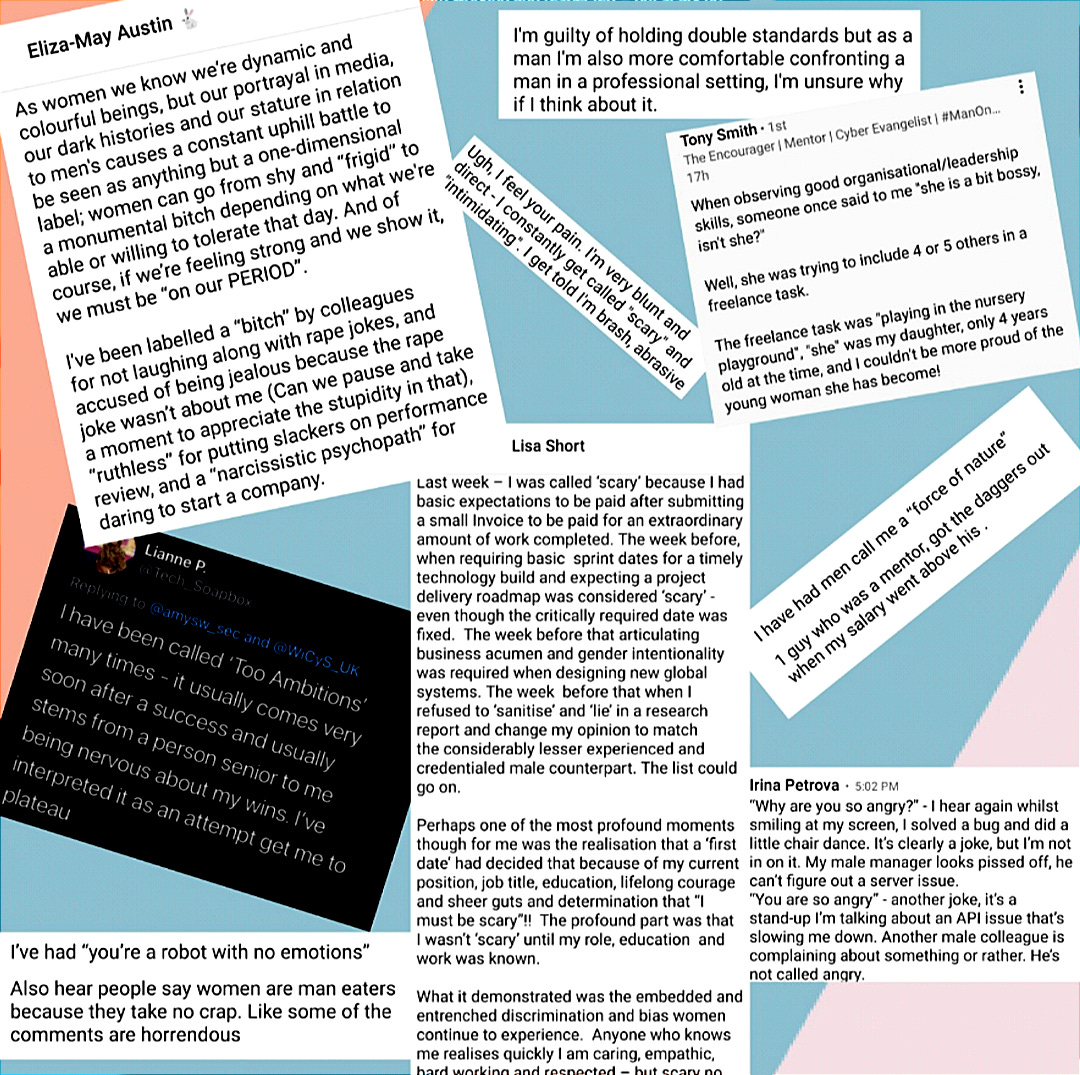
It’s clear: sadly these aren’t just isolated or rare incidents, they happen to women around the world every day.
To all the women who resonate with this article, you still have a choice.
You can let the (biased) perceptions of those around you affect your confidence and withdraw. Or you can wield the power of introspection to push forward and prove them wrong.
You have strengths not only in your workplace but outside of it too. Remind yourself of these strengths through value affirmations.
You are worthy.
You are knowledgeable.
You are enough.
Research has shown that value affirmations can mitigate gender performance gaps in competitive business environments.
To everyone else on the planet: reflect and speak up!
If you believe a woman is any of the descriptors I’ve listed at the top of this article, check yourself first. Ask yourself:
Why do I think this?
Does it stem from bias? Even one I may not be aware of?
Am I projecting my feelings (jealousy or insecurity) onto someone else?
Please speak out if you see or overhear someone struggling because of one of these biases. Challenge the bias so people start to learn and become more conscious of it.
We can all work together to forge a more inclusive world.
And finally — all you fabulous, strong, successful women out there: KEEP BEING YOU.
Don’t shrink yourself to make others feel more comfortable.
You’re extraordinary as you are.